The Memoir · chapter 1 of 42
Opening: Taking Stock
Time flows on and relentlessly draws us toward the finale. Again and again the thought arises of taking some kind of stock. With time it becomes clear that you have left no particular mark. Having crossed paths with venerable veterans whose shoulders bear the highest honors, adorned with three-star epaulets1 Three-star epaulets In the Soviet military, three-star epaulets marked the rank of colonel. The author is measuring himself against decorated war veterans and high-ranking officers, and feeling that his own life left no comparable mark, the comparison that sets off this whole opening reflection. Note 1 · all notes , and whose chests are covered in medals, you realize how insignificant your own contribution to the common till has been.
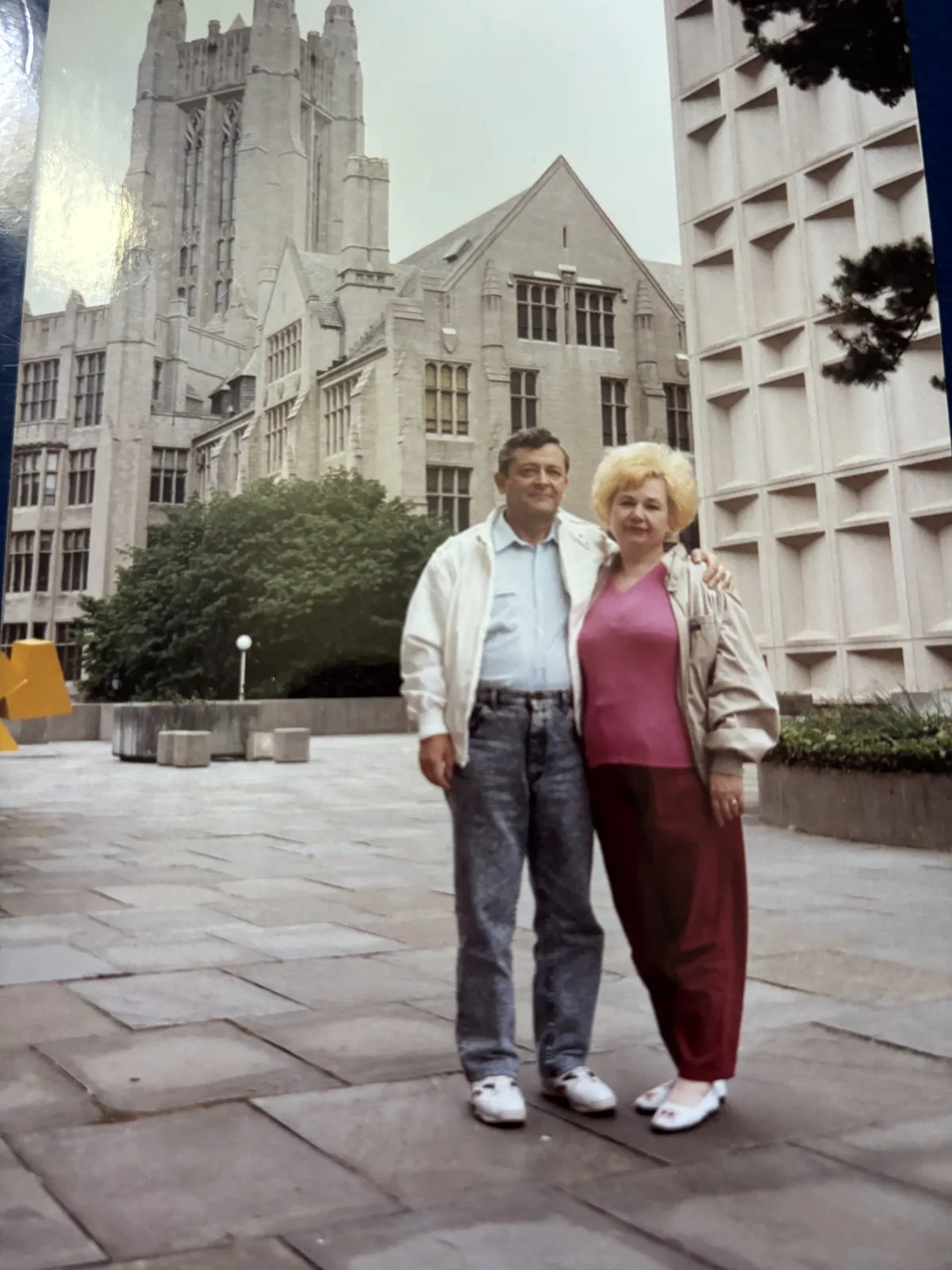
And yet it counts for something: that the family has stayed together into old age, that there is a good daughter, a good granddaughter and their families, and that there is a friend and lifelong companion at your side. So one thinks that life was not lived in vain. There is a certain wish to tell my family, and some of our friends, about our roots, about life’s episodes, about the memorable people I crossed paths with, about the life of my generation. Especially now, when I have had to leave the homeland, where the graves of my ancestors remained, along with the fruits of my own labor.
With bitterness and longing you observe, from here, from across the ocean, how the results of the creative and useful labor of millions of people are mercilessly destroyed, for the sake of the political and power ambitions of certain individuals and cliques. It was possible, in the end, to carry out any perestroikas2 Perestroika Russian for “restructuring.” The program of economic and political reform launched by Mikhail Gorbachev in the mid-1980s. The author, writing from abroad, treats it as the beginning of the unraveling he is describing, the reforms that, in his view, ended by destroying the Soviet economy rather than mending it. Note 2 · all notes , to play any political games, but in no case to destroy the sphere of material production, since only it, in the final reckoning, can provide a person with work, shelter, food, and the other benefits of modern civilization. No activity (political, financial, commercial, cultural, and so on) can meet the needs of society if the sphere of material production is broken. This essential side of the matter was overlooked by short-sighted politicians. This boundary was crossed, and a collapse turned into an avalanche, which is very hard to stop. Much sweat, and maybe blood, will have to be spilled to restore even the former level of material production.
By now it is perfectly clear that all the dyed-in-the-wool nationalists (the “ samostiyniki3 Samostiyniki From the Ukrainian samostiynist, “independence” or “self-reliance.” A term for those who pushed for the Soviet republics to break away and become independent nations. The author uses it pointedly and with scorn, he held the nationalist movements responsible for shattering the economic ties he believed ordinary people depended on. Note 3 · all notes ” in Ukraine, in Kazakhstan, Uzbekistan, Tajikistan, and the rest of their ilk) grossly miscalculated, counting on a flourishing life, but on their own, since with any separation it was necessary first of all to provide for the conditions of preserving material production. But since this was not done, that production is dying out, and saving it is now practically impossible. The matter is heading toward collapse. What “ privatization4 Privatization Under the Soviet system nearly all enterprises, land, and housing were owned by the state. “Privatization” meant transferring that state property into private hands, a central, and deeply contentious, feature of the post-Soviet economic changes of the early 1990s. The author puts the word in scornful quotation marks, doubting that it could work amid the collapse of supply and production he is describing. Note 4 · all notes ”? What “market”? Where will you get the component parts for Kharkiv tractors or Lviv televisions5 Kharkiv tractor plant and Lviv television factory The Kharkiv tractor plant (in Ukraine) and the “Elektron” television factory in Lviv were well-known Soviet manufacturers. The author names them deliberately: their products were assembled from parts made in factories scattered across many Soviet republics, so when the union broke apart, the supply chains these plants depended on were severed. This is the heart of his argument, that political separation destroyed the practical machinery of everyday life. Note 5 · all notes from hundreds of suppliers, where will you get fuel for motor transport and metallurgy, and so on and so forth? That is, the severed economic ties must be restored, and that today is practically hopeless (in any case for the foreseeable future). A great deal of time will pass, maybe many decades, at a minimum, until the sphere of material production reaches the level of 1988. And this under favorable conditions.
Related: the contents · the glossary · the family record · the etymology of the family's names.