The Memoir · chapter 10 of 42
School and Teachers
In Kyiv I went to study at my beloved school no. 25, ten minutes’ walk from home. The school had been built just before the war, opposite the magnificent Church of St. Andrew the First-Called, raised by Empress Elizabeth to the design of the great Rastrelli. The school stood, in fact, on the site of the terem of the Grand Prince of Kyiv. We took these historic places for granted, without sacred awe, and yet close by stood St. Sophia’s Cathedral, the church built by Yaroslav the Wise about a thousand years ago. On Bohdan Khmelnytsky Square, the ensemble of St. Sophia includes a bell tower raised by Peter the Great in honor of the victory over the Swedes at Poltava . Nearby is Vladimir’s Hill, with the monument to Prince Vladimir, who baptized Rus a thousand years ago. It is hard to convey the beauty of the view that opens from the wonderful little square (the Andreevsky garden) on Andreevsky Spusk57 Andreevsky Spusk One of Kyiv’s oldest and most prestigious streets (the Andriyivskyy Descent). When most Soviet families shared crowded communal apartments, to be given a private apartment here was a real mark of rank and privilege. Note 57 · all notes . Below flows the beautiful Dnieper, and beside it, in springtime, a riotous ocean of green on the slopes, dotted with blossoming acacia and lilac. I remember all this, and I grieve and yearn that I did not understand it, did not value it, and now, alas, it is too late!
My school years passed quickly. I studied alongside good fellows: Adolf Pritsker (now a senior manager at a leather plant in New Jersey); Vitya Litvak, long since a doctor of sciences at the Antonov design bureau; Tolya Kitaygorodsky, who became a research physicist; and many others. But now, as the saying goes, some are no more, and those are far away.
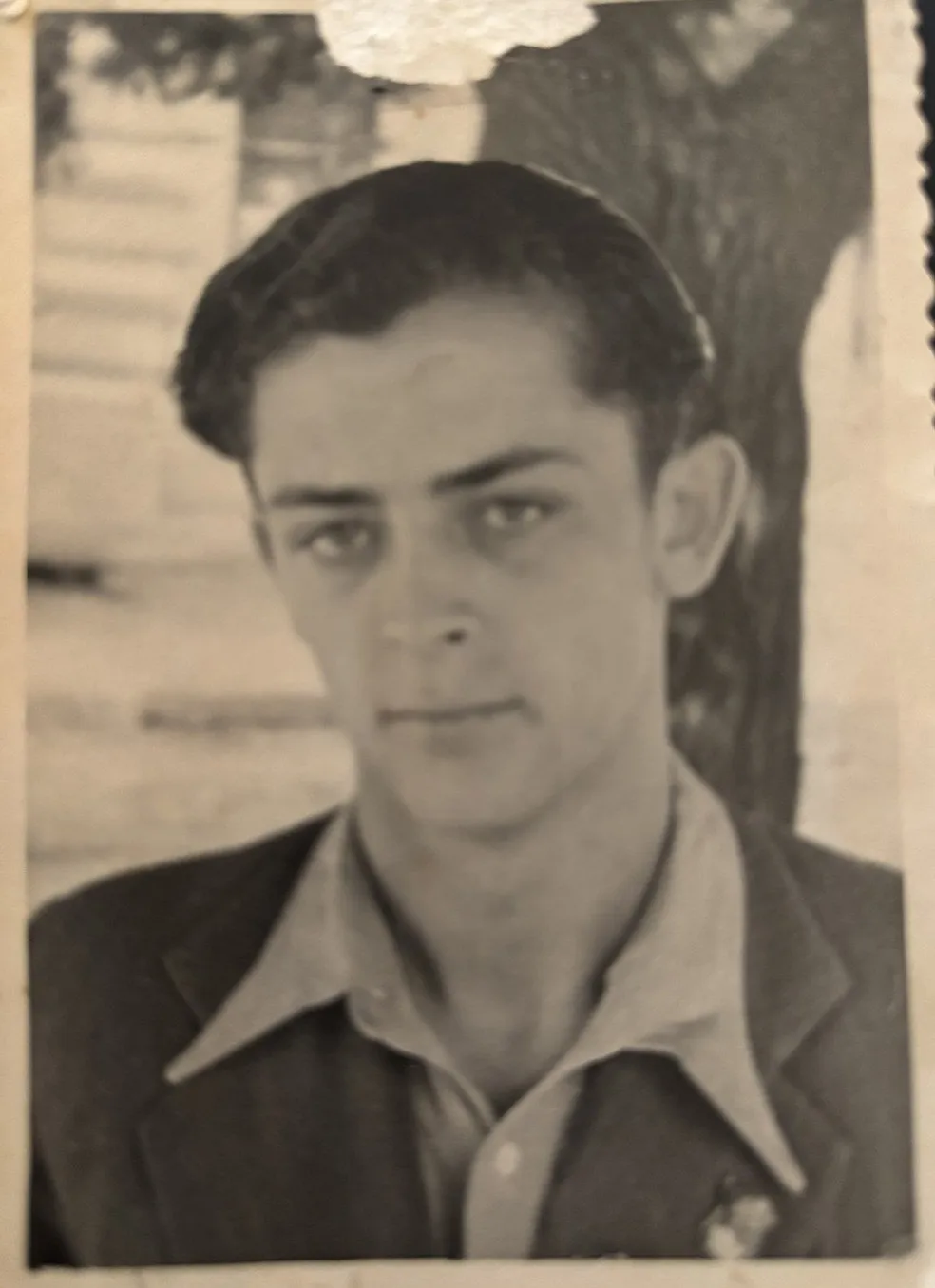
There were wonderful teachers at the school. My first teacher was Nina Dmitrievna. I managed to find her forty-five years later on Andreevsky Spusk, by then more than ninety years old, and I introduced my wife to her sometime in 1985. In the postwar school there were interesting people: Rakhil Moiseevna Akselrod, the history teacher. A clever woman. She could fire us up for any good cause. We owe her a debt for instilling a taste for discussion, for debate, and, in the end, for the cultivation of personal erudition. The remarkable physicist Nikolai Andreevich Pushkar, thanks to him I grew fascinated with electrical engineering, then came to love it and gave it my whole life. The mathematician Anatoly Ivanovich Skorobogatko, outwardly a dry pragmatist, but in essence a man with encyclopedic knowledge of literature and art.
Our secondary school taught soundly and reliably, giving sufficient attention both to literature and to the exact sciences. I look with misgiving at the system of education in the USA, judging by the example of my granddaughter Stacey. Who needs all this fuss with “making posters” and endless “projects,” when the heart of the subject gets buried under showy window-dressing? We finished secondary school (here that is “high school”) with a solid store of knowledge in many fields, and went boldly on to higher school (here that is “university”). It is no wonder that our specialists today, in the USA, can offer worthy competition to American specialists.
I finished school with a silver medal and entered, without examinations, the electromechanical division of the mining faculty of the Kyiv Polytechnic Institute, the famous KPI64 KPI (Kyiv Polytechnic Institute) One of the Soviet Union’s most prestigious engineering schools, broadly comparable to MIT in standing and selectivity. Admission was fiercely competitive, and Jewish applicants faced quiet but systematic discrimination, quotas and entrance examinations were often used to keep their numbers down. The author’s silver medal, which let him enter without examinations, spared him that gauntlet. Note 64 · all notes of Kyiv. The group that came together was a peculiar one, ninety-five percent rural youth. Grisha Danilchuk, later a docent of the department, used to say: “I never had boots, I never slept on a sheet.” At the faculty there was a raised stipend and a handsome uniform with contra-epaulets and gold buttons.
The system of teaching in the general departments of the KPI was peculiar, with great traditions. I grasped fairly quickly what was needed in order to master a course and pass it successfully: you had to have a summary of all the lectures. And so I stubbornly and conscientiously attended practically all the lectures and carefully took notes on them, which made it possible to absorb the material well, and, instead of toiling and sighing away in the reading room, to prepare for the examination session comfortably, sitting at home at mama’s. As for the course projects, here one had to sweat, and considerably. I do not know how it worked for others, who seemed to do nothing and yet had everything in order.
With us, everyone worked like a draft horse. I would come home at two in the afternoon, take an hour for food and rest, and already at three I would sit down and work until one or two in the morning. And only such intensive work made it possible to complete all the graphic and computational parts of those countless course projects (beams, diagrams, design drawings, an electric motor, a substation, mine transport, automation, and so on and so forth). Over ten semesters, roughly a hundred projects, tests, and examinations were completed and passed.
Our practical training took place at the mines of the Donbass. As a rule, we were taken on and worked as electrical fitters at underground extraction sites. I learned well what the “heroic”, and in essence slave, labor of miners in the coal pits really is. How reluctantly people go off each day to work underground, into the dark and the damp, and with what delight they come back up to the light of day. And nevertheless I must state that to be a student, to study and to pass examinations, is considerably harder than to work at any difficult or heavy job. And let no individual hypocrites try to convince me that work is, after all, harder than study. That is a lie.
Related: the contents · the glossary · the family record · the etymology of the family's names.