The Memoir · chapter 5 of 42
The Terror, 1936–38
The period of 1936–38 began; the arrests started, of close friends, former partisans, honest party members. One of Yakov’s friends, a partisan of the Civil War and a holder of an Order (which in those years was a great rarity), Misha Ziskind, worked as director of the Kyiv K. Marx confectionery factory. He was arrested, his wife too, the children sent to an orphanage35 Children sent to an orphanage Under the Terror, the families of the arrested were treated as guilty by association. Wives were frequently arrested as “family members of a traitor to the motherland,” and their children were taken and placed in state orphanages, often under changed names. This is why the detail recurs, it was standard practice, not an isolated cruelty. Note 35 · all notes . A fellow countryman of my father’s, the Order-bearer36 Order-bearer A recipient of one of the Soviet state’s official decorations (such as the Order of the Red Banner). In the 1920s and early ’30s these were rare and carried great prestige, which is the author’s point: even the most distinguished and loyal revolutionaries were not safe. Both men he names, Ziskind and Skulsky, were decorated heroes, and both were arrested anyway. Note 36 · all notes Skulsky, head of the political administration of the NKVD32 NKVD and the “rhombus” insignia The NKVD was the Soviet interior ministry, which in this era controlled both the regular police and the secret police that had grown out of the Cheka. The “rhombus” was a diamond-shaped collar insignia marking senior command rank, which the author equates with a general’s. Yakov’s wearing it signals how high he had risen within the Soviet security and police apparatus. Note 32 · all notes of Ukraine, arrested, his wife too, the daughter sent to an orphanage. Yakov used to come home from work at night (1–3 a.m.); the lights would be turned off at once, and in a whisper he would tell his wife who had been arrested over the past day.
Once, having arrived home at night and not yet managing to take off his boots, he heard the noise of a car stopping by the house and saw from the window two Chekists heading toward our front door with the dvornik37 Dvornik A dvornik was a yard-keeper or building caretaker, responsible for cleaning and maintaining a building and its courtyard. In the Soviet era the dvornik also served as the authorities’ eyes on the residents and was customarily brought along as an official witness during arrests, which is why his appearance alongside the two Chekists makes Yakov assume they have come for him. Note 37 · all notes . “Well, this is for me!” Yakov decided. “Farewell, wife, don’t wake our son, let him sleep.” He opened the door, and there, with a salute, one of the new arrivals asked in an apologetic voice: “Excuse me, Comrade Litvak, I urgently need to make a call, and the only private telephone on the whole street is yours.” They had come to take someone on our street, and that person turned out not to be home. So they needed to report quickly to their superiors.
A few days later Yakov went to the investigator for especially important cases38 Investigator for especially important cases A senior NKVD interrogator who handled the most serious political cases, hunting for “traitors” and “enemies of the state.” This was a powerful figure to whom ordinary people had no access, which is why Yakov’s being able to go to him directly, and to ask whether his own name had come up, was so unusual. Note 38 · all notes , took off his belt with the inscribed Browning39 Browning (presentation pistol) A Browning pistol, here an engraved presentation weapon, awarded as an honor. Yakov surrendering his inscribed Browning to the investigator is him handing over a token of his own distinguished service, in the expectation that he was about to be arrested like the others. Note 39 · all notes , and said: “I can’t wait any longer. Take it, evidently my turn has come.” The man made a phone call: “Is there anything on Litvak?” Receiving the answer, he said: “There’s nothing on you. When the proof materializes, we’ll take you.” That is, one had to live in expectation of the blow, which could come at any moment and destroy the whole family.
It’s unknown who prompted it or how, but Yakov “fell ill” and took to a hospital bed (there were wounds and grounds enough). The doctors found in him a host of cardiac and other disorders. The medical board decided: bed rest, not to be allowed to work. This group of remarkable old Kyiv doctors (among them several Jews), evidently, understood the situation perfectly and in fact saved him from arrest. After some time he was declared an invalid and retired.
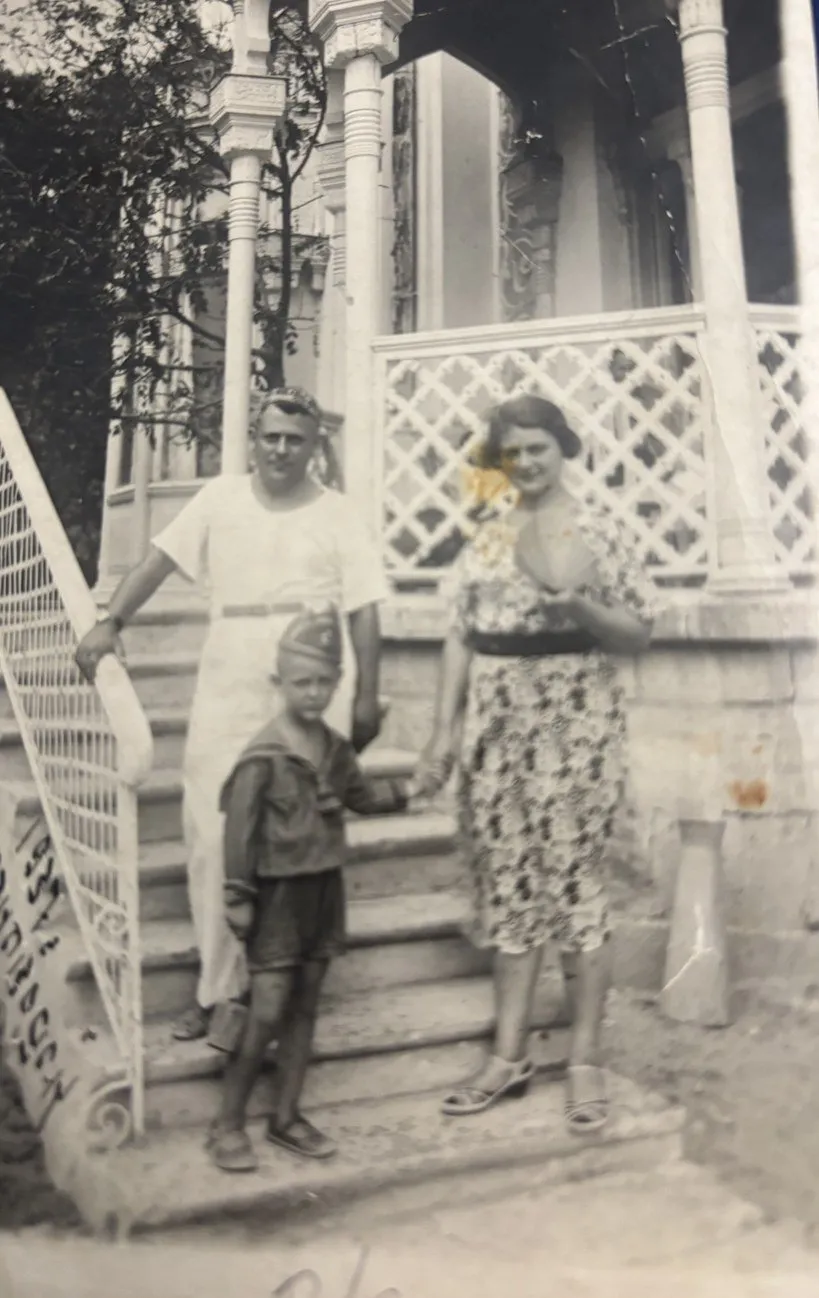
The trip followed Yakov’s medical retirement: the doctors’ ruling that his heart left him unfit to work, which removed him from the NKVD and, in all likelihood, saved his life during the Terror.
In 1939 a thaw set in40 Thaw A temporary easing of the Terror. After Yezhov’s fall in late 1938, the arrests slowed and many prisoners were released. This is not the same as the later, more famous “Thaw” under Khrushchev in the mid-1950s, when repression eased after Stalin’s death; here the author means only the brief letup of 1939. Note 40 · all notes . More than half of those taken were released, because Yezhov41 Yezhov, Nikolai (1895–1940) Head of the NKVD from 1936 to 1938 and the chief organizer of the mass arrests and executions of the Great Terror, which is why that period is sometimes called the Yezhovshchina (“the Yezhov era”). When the scale of the killing became an embarrassment, Stalin had him removed and later shot, and a portion of his victims were released, which is the “relaxation” the author describes. Note 41 · all notes had overdone it. But those who had been shot in 1936–38, naturally, did not live to see release. Yakov, as an NKVD invalid, received a voucher to Sochi42 Sochi (and the “voucher”) A resort city on the Black Sea coast, long the favored place for officials and the privileged to be sent for rest and medical treatment at state expense. A “voucher” (putyovka) was an official allocation of such a stay, here, part of restoring Yakov to good standing after he survived the Terror. Note 42 · all notes and took his wife and son with him. At that time rehabilitated Chekists were being treated and rested there. Everyone had their uniforms, decorations, and weapons returned. Everyone joked, embraced, told tales of their own circles of hell behind bars. On meeting Yakov they often asked: “Where did you do your time?”
Yakov was invited back into the security service. But he switched to economic work and was appointed head of the State Trade Inspectorate of the city of Kyiv. In doing so he made an egregious mistake, taking on former Chekists into his staff. Some of them had at one time held higher posts in the NKVD and OGPU43 OGPU The Soviet secret police of the 1920s and early 1930s, the successor to the Cheka and the forerunner of the NKVD and KGB. As a private trader, grandfather was inevitably under its scrutiny. Note 43 · all notes than Yakov, and naturally were displeased to be under his command. Besides, the position gave the chance to obtain illegal extra benefits. Yakov waged a struggle on two fronts, against crooks in trade and against his own inspectors, who undermined him at every opportunity. It couldn’t go on like that for long, and he secured his transfer to other work: deputy manager of a trust that dealt with defense installations. That is where the war found him.
So ended this significant stretch of his life.
It should be noted that, as a veteran of the partisan and revolutionary movement, he had occasion to meet famous people of that time. He was acquainted with the hero-aviator Chkalov44 Chkalov, Valery (1904–1938) A celebrated Soviet test pilot, famous for a record-setting non-stop flight from Moscow over the North Pole to the United States in 1937. He was one of the great public heroes of the era, so meeting him marked Yakov as a man who moved in important circles. Note 44 · all notes and with the All-Ukrainian elder G. I. Petrovsky45 Petrovsky, Grigory (1878–1958) A senior Bolshevik who served for years as the formal head of state of Soviet Ukraine. “All-Ukrainian elder” (vseukrainskiy starosta) was his affectionate nickname. The industrial city of Dnipropetrovsk, mentioned earlier in the memoir, was named after him. Note 45 · all notes . People’s commissars and generals visited his home. Once the well-known young poet Sergei Mikhalkov46 Mikhalkov, Sergei (1913–2009) A Soviet writer best known for children’s verse and for writing the words to the Soviet (and later Russian) national anthem. The author notes the family connection because Sergei’s son Nikita Mikhalkov became one of Russia’s most famous film directors and actors, familiar to later generations. Note 46 · all notes stayed with him (father of the present-day film director and actor Nikita Mikhalkov). Yakov was a sociable and cheerful man, loved to joke, sang well, loved theater and opera.
Related: the contents · the glossary · the family record · the etymology of the family's names.