The Memoir · chapter 13 of 42
Theater, Music, and the Arts
From childhood I had a passion for the theater. I especially loved classical opera, and often went to the productions of the Russian theater and of the Ukrainian Franko theater. I admired the great Ukrainian actors: Gnat Yura, Bugma, Uzhviy, Ponomarenko74 Ukrainian stage: actors and singers The names the author lists were the celebrated artists of the Kyiv theatres in the 1940s and 1950s. Gnat Yura (1888–1966) was the founding director and leading actor of the Franko Theatre; Amvrosiy Buchma (“Bugma,” 1891–1957), Natalia Uzhviy (1898–1986), and Yevgeny Ponomarenko (1906–1977) were among its foremost players. Among the singers, Ivan Patorzhinsky (bass) and Borys Gmyrya (bass-baritone) were stars of Ukrainian opera, while Pavel Lisitsian, Sergei Lemeshev, and Vera Davydova were renowned voices of the Bolshoi in Moscow. To an English reader these are the equivalent of naming the leading lights of a national theatre and opera in their golden age. Note 74 · all notes . I greatly loved the outstanding singers: K. Lapteva, I. Patorzhinsky, Kocherga, B. Gmyrya. I always listened with delight to the Moscow singers: Pavel Lisitsian (who possessed an inimitable timbre of voice), Lemeshev, Ivanov, V. Davydova. V. Davydova was a beauty. Stalin courted her and proposed that she become his mistress, but she kept faith with her husband.
A love of the theater and of music was instilled in me by my father, who was a great lover of operatic and theatrical art. My wife and I later tried to pass this love on by inheritance to our daughter, and I am glad to record that the attempt succeeded. My daughter loves the theater, loves music, loves the opera, loves culture in many of its forms.
Of the Ukrainian classics I was very fond of Kropyvnytsky’s pieces, “Vanity” (Sueta)75 Ukrainian theatrical works Staples of the Ukrainian repertoire. Marko Kropyvnytsky’s comedies of manners “Vanity” (Sueta) and “The Sea of Life” (Zhiteyskoye more) are classics of the nineteenth-century Ukrainian theatre. “Stolen Happiness” (Ukradene shchastya) is Ivan Franko’s celebrated 1893 drama of love and fate among the village poor; “In the Steppes of Ukraine” and “The Destruction of the Squadron” (Gibel eskadry) are Soviet-era plays by Alexander Korniychuk. Together they formed the backbone of what a Kyiv theatregoer of the author’s generation would have seen again and again. Note 75 · all notes and “The Sea of Life” (Zhiteyskoye more). These productions were staged with great brilliance and stayed in my memory for life. In them shone the unforgettable Gnat Yura, Yevgeny Ponomarenko, Olga Kusenko. The pieces of the I. Franko theater, “Stolen Happiness” (Ukradene shchastya) with Bugma, Uzhviy, and Dobrovolsky, and “In the Steppes of Ukraine” with Milyutenko, Shumsky, and Yakovchenko, will remain forever in my memory. Much for Ukrainian drama was done by Alexander Korniychuk. He wrote “The Destruction of the Squadron” (Gibel eskadry) and a host of other plays. His wife, the distinguished Polish writer Wanda Lvovna Wasilewska, exerted a very strong influence on him, and, despite the censorship, his works always contained elements of criticism. In the war years he wrote the play “The Front,” which was published in full, in installments, in Pravda62 Pravda Russian for “Truth.” The official newspaper of the Communist Party and the most authoritative publication in the Soviet Union, whose line every other paper was expected to follow. When even Pravda joined the campaign against Jewish doctors, it signaled that the persecution was sanctioned at the very top, which is why the author names it first. Note 62 · all notes . Later, after the war, V. Wasilewska died, and Korniychuk married another woman. In the 1980s he lay in an oncological clinic with cancer. He had separate apartments there, where his wife was permitted to stay and where religious holidays were observed, for instance, they would “keep the fast” when the time came. He died and was buried at Baikove cemetery, not beside, but along the same central avenue as Wanda Wasilewska.
The people of Kyiv greatly loved the Lesya Ukrainka Theater of Russian Drama. There, alongside the classics, Chekhov and Ostrovsky, interesting contemporary pieces were always staged. There played the wonderful actors Nikolai Romanov, Strelkova, Belousov, Dukler, Shvidler, Rogovtseva, L. Glaz, Vysotsky, Draga, and others. I greatly loved that theater and felt very much at home in it. It was, as it were, my theater and my actors. We especially remembered “Don Carlos”, a complex, unwieldy piece, but executed with great scrupulousness and great mastery. Everything there was in harmony: the inspired acting, the sets, and the costumes.
Special love was enjoyed by the Kyiv Shevchenko Theater of Opera and Ballet. Before the war such famous singers shone there as I. S. Patorzhinsky (bass), O. I. Lytvynenko-Wolgemuth (soprano), and the outstanding Oksana Petrusenko (the Ukrainian nightingale). The theater’s repertoire was broad. Every year the stage held Verdi, Gounod, Tchaikovsky, Rossini, Donizetti, Lysenko, and others. The theater had a remarkable company of singers and a ballet. I especially loved K. Laptev (baritone), Solovyanenko (tenor), Kocherga (bass), Gmyrya (baritone), Tuftina (mezzo-soprano), Gulyaev (baritone), Gnatyuk (baritone), B. Rudenko (soprano), Lobanova, Miroshnichenko, E. Chavdar. At the conductor’s stand stood such masters as V. Piradov, S. Tolba, St. Turchak. In the ballet shone the prima E. Potapova and Vizirenko-Klyavin, Larisa Gerasimchuk. An especially vivid impression of music and dance was left by Minkus’s ballet “Don Quixote,” with Larisa Gerasimchuk and her husband Alexei Apukhtin. The staging, costumes, lighting, and dancing of this production made a far more gripping impression than the same ballet at the Metropolitan Opera. In the corps de ballet there danced my schoolmate Esya Yegorov, and in the productions sang my acquaintance and friend Rudolf Belitsky. The director of the theater was Nikita Khrushchev’s son-in-law, V. Gontar.
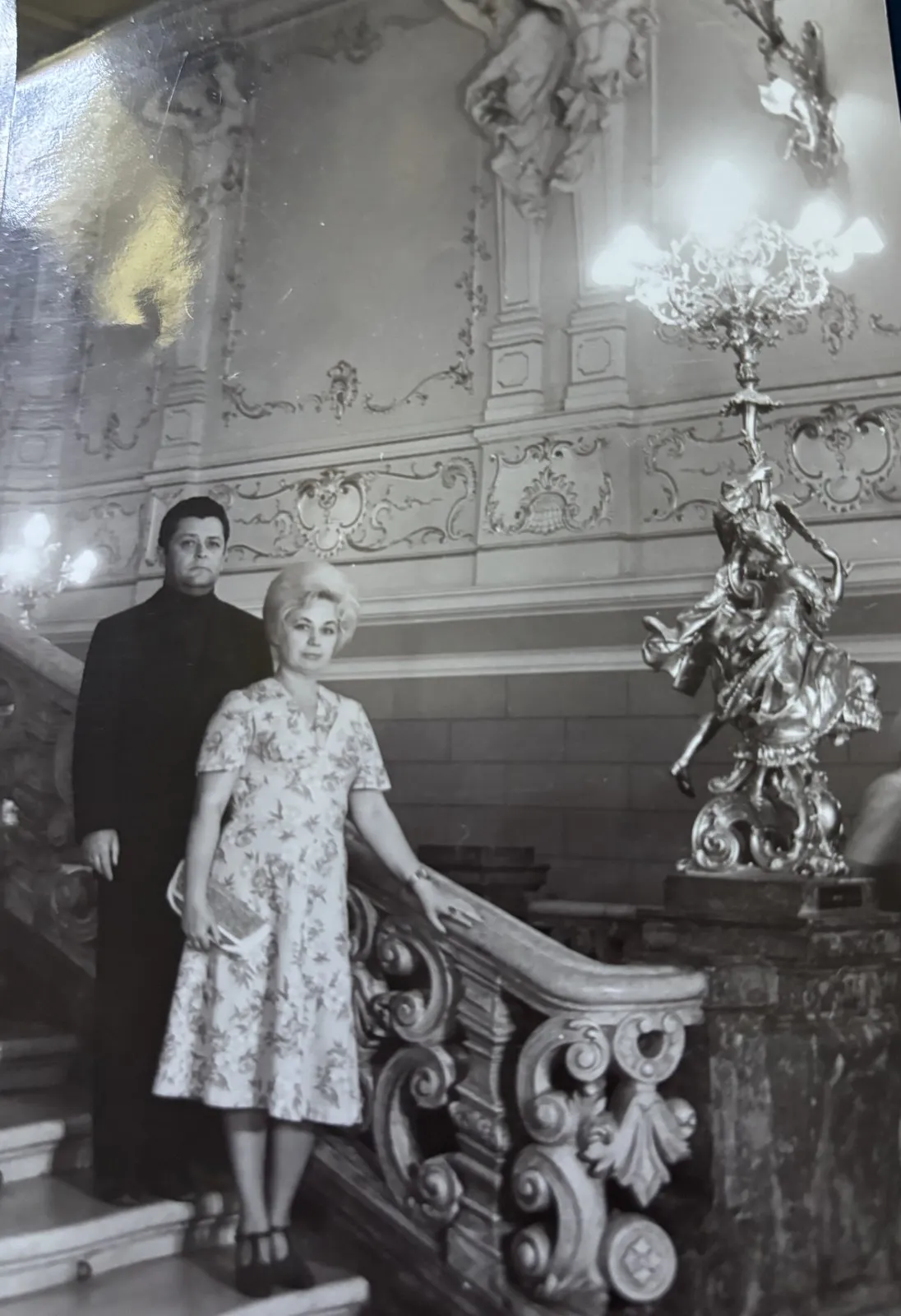
I should particularly like to note the Ukrainian State Symphony Orchestra under the direction of Natan Rakhlin. They gave Sunday concerts of symphonic music in the wonderful Pervomaisky Park on the slopes of the Dnieper. They performed Tchaikovsky’s First Concerto, and his Sixth Symphony, and the Festival Overture of 1812, the last with trumpeters brought in from the military band of the Kyiv Military District and with the ringing of bells in the finale. There, on summer Sundays, one could hear the very finest works of native and foreign composers in such remarkable performances. Once they were playing the “Italian Capriccio.” Its solitary trumpets begin. But… something did not please N. Rakhlin, and he stopped the orchestra and made them repeat the trumpet introduction. But… again something did not please him, and a third time he began the “Capriccio” from the start. And… alas, again it was not right. With a shout of “I cannot!” Rakhlin flung down his baton and walked off from the stand into the wings. The audience of thousands begged him to return, the applause rolled on, but he did not come back for more than half an hour. Evidently a false note in the trumpet’s playing had thrown him off balance. All the same, I think there was an element of caprice in it, and of disrespect for the public.
Good concerts were given at the Kyiv Philharmonic. A special place here was held by the concert of our universal idol, Mikhail Aleksandrovich. He captivated us all with his recordings of Italian songs and romances, and of arias from various operas. And naturally, when he came to Kyiv, it was impossible to get tickets to his concert. But my papa, knowing my love for Aleksandrovich’s voice, used his influence, and I had a ticket to the Philharmonic. Of course, this singer possessed a brilliant technique and a high voice, though not a very powerful one. People said that before this he had been a cantor in the Riga synagogue. But now he was a soloist of the Bolshoi Theater and a laureate of the Stalin Prize.
Our young people in those days were captivated by the variety ensembles of Leonid Utesov and Oleg Lundstrem. We greatly loved, and went to, the concerts of Klavdia Shulzhenko, who performed together with her husband Vl. Koralli (who was, by the way, a very poor partner). Great success was enjoyed by the melodies of the American jazz composer and conductor Glenn Miller, which he wrote and performed in the wonderful film “Sun Valley Serenade.”
At that time there were only three state theaters in Kyiv, and native Kyivans, as a rule, went precisely to these theaters, and often in the foyer one met the same familiar faces. We greatly enjoyed the tours of the famous Moscow theaters: the Maly Theater, the Moscow Art Theater, the Theater of the Soviet Army. Here we could see such masters as Pashennaya, Gogoleva, Tsarev, Yanshin, Zharov. Once, walking along Lenin Street, I caught sight of M. Zharov. It was summer; he was carrying his jacket in his hands. I walked behind him and marveled at his bearing and his great height. In summer, on the Kreshchatik20 Kreshchatik Kreshchatik (Ukrainian: Khreshchatyk) is the principal avenue of central Kyiv, running through the city’s commercial and civic heart. Its central position made it a natural axis of movement, and of the street fighting, during the 1918 uprising. Note 20 · all notes , I met Rostislav Plyatt, who was walking in a canvas suit with a short-sleeved jacket and tenderly leading by the arm Vera Maretskaya, his constant stage partner. I met Ivan Pereverzev, who acted in the film “T. Shevchenko,” and the actor Kmit, Petka from “Chapaev.” Yes, after all, we were raised and brought up in a love of art. This feeling was cultivated in the family, at school, at the institute. Going to theaters, concerts, exhibitions, listening to recordings, and so on gave our souls a great charge of culture and of love for it for our whole lives.
Recalling my youth, there are moments I would rather not speak of. This is, first of all, my unsuccessful first marriage. Having married, I moved into someone else’s family, onto “the mother-in-law’s grub.” This was unwise and in the end led to divorce. It was a blessing that there were no children.
Related: the contents · the glossary · the family record · the etymology of the family's names.