The Memoir · chapter 16 of 42
Postwar Kyiv
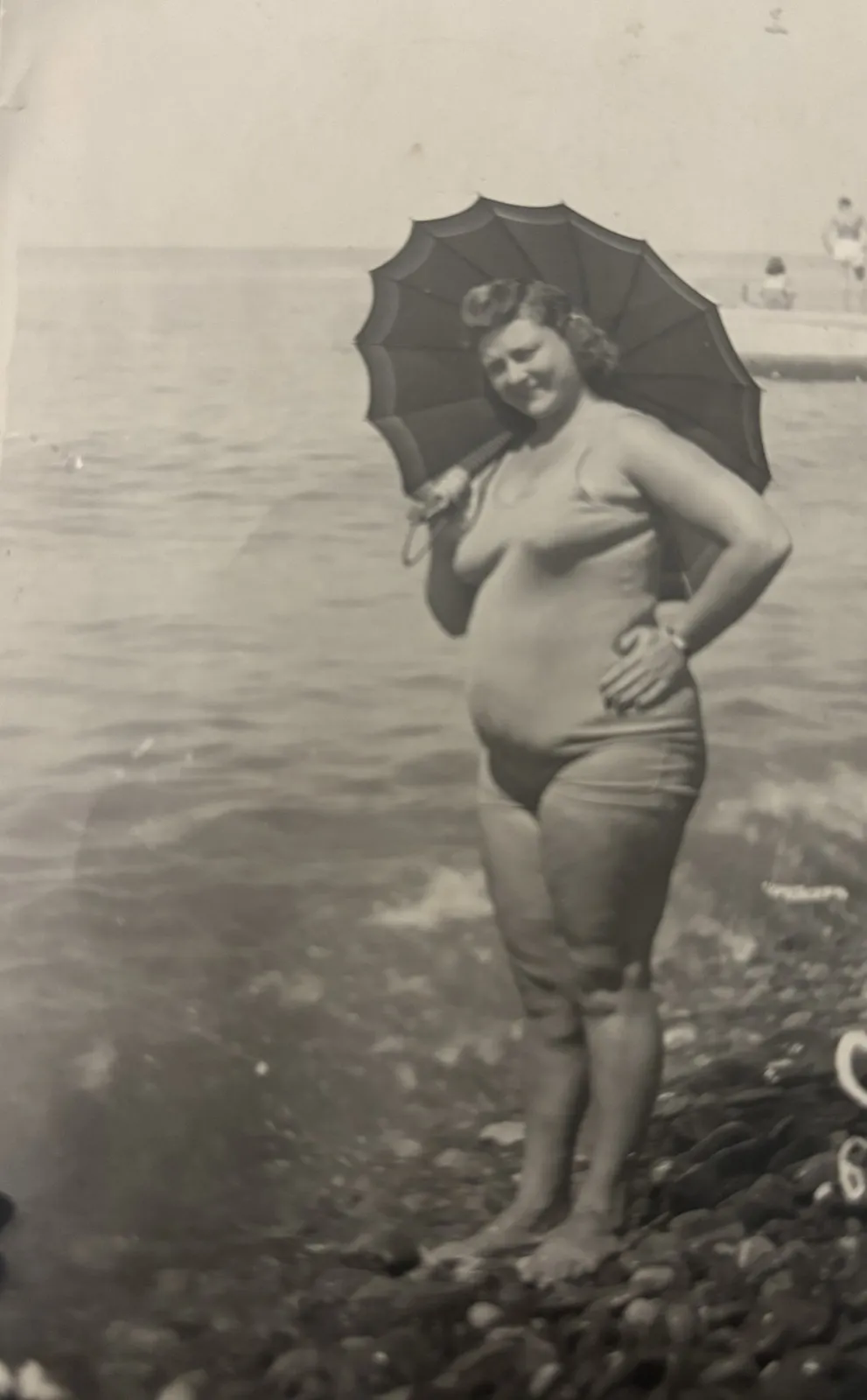
A family holiday at the Black Sea’s most prestigious resort in the summer of 1946, barely a year after the war’s end, while much of surviving Jewish Europe still lived in displaced-persons camps and Kyiv itself got by on the black market, is a measure of the protection the family’s standing in the Soviet apparatus afforded them. The Sochi “voucher” (putyovka) was precisely such a perk of rank.
In the years 1944–1946, in Kyiv almost everyone traded or stole something, since on the meager ration card82 Ration-card system (kartochki); “litera A,” dry ration (SP) During and after the war the Soviet state controlled the distribution of food and basic goods through ration cards (kartochki), which entitled the holder to a fixed allotment of bread, fats, sugar, and the like. This was not merely a discount or supplement: it was, in principle, the only legal way to obtain such goods, because the ordinary shops stood largely empty, there was simply nothing on the shelves to buy with money alone. Rations were graded by rank and importance, and the higher categories carried more and better food; the “litera A” was a top-tier ration reserved for senior officials, and the “dry ration” (sukhoy payok, abbreviated SP) was a packaged allotment of staples. Because even the best official rations were not enough to live comfortably, and because there was no shop where extra food could simply be purchased, families of every station, including the author’s, turned to the bazaars and the black market to survive. This is the whole point of the chapter: a senior militia officer’s own household quietly trading on the flea market, because the legal economy could not feed them. Note 82 · all notes you could “stretch your legs.” Something analogous is happening now too, everyone trades or engages in commercial activity in order to survive. A joke of those years: “Four houses side by side: in the most beautiful live the litera-tors, in the worse one, the liter-Be-tors, farther on, simply the takers, and in the worst, the so-so-ers.”
I cannot forget our neighbor across the landing, General Fomin, Sergei Mikhailovich. At the end of the war he occupied at once two adjoining apartments, whose tenants were resettled83 Communal apartment (kommunalka) After the revolution the state seized private housing and packed multiple families into former single-family apartments, allotting each family a single room and forcing them to share one kitchen, one bathroom, and one corridor. This crowded “communal apartment” was the normal way ordinary Soviet city-dwellers lived for decades, and decent housing was perpetually scarce. That is what gives the detail its sting: for General Fomin to take over two entire adjoining apartments for himself alone meant that the several families who had been living in them, quite possibly a dozen people or more, were turned out and “resettled” elsewhere, so that one powerful man could have a grand residence while everyone around him made do with a single room. Note 83 · all notes . He was a very distinguished general, but, alas, not a “combat” one. He held the post of deputy commander of the occupation army for repatriation. His task included the repatriation of prisoners and of the civilian population driven into Germany. Clearly the aim was humane, but it fell into unclean hands. To begin with, his residence was in Potsdam , where he occupied the mansion of one of Himmler’s deputies. And methodically the entire furnishings, utensils, and portable goods from this mansion were relocated to the apartment next to ours. Of course, the apartment could not hold everything, and he constructed (with the labor of soldiers and from delivered materials) a solid storehouse-garage. There stood two luxurious “Wanderer” automobiles and bales of carpets, curtains, tapestries, porcelain, crystal, and so on. In the apartment there were two excellent pianos. One piano had been brought from Göring’s palace and was valued by Kyiv antiquarians at 100 thousand rubles (big money in those days).
My distant relative, a lieutenant colonel of justice, served in the investigative department of the Central Group of Forces. He told that the military prosecutor’s office had begun to pursue the case of this general actively and had brought him to criminal responsibility for official crimes connected with the theft of provisions. The general quickly went to the commander, Marshal Konev, and the latter ordered the case to be shut down. But the general was booted out of Germany. As we see, he settled in not badly in the KVO (Kyiv Military District). When there was a total reduction of forces in 1958 under Nikita Khrushchev, many generals were forced to retire. He left too, and apparently did not live in want, since his plundered stores must have lasted a long time. He was once at the river and, being sweaty, took a swim. Afterward he fell ill, something with the lungs. Then a sharp deterioration began, accompanied by severe pains. They say he screamed: “F… your mother, I want to live.” But all his riches did not help, God punished him. He died.
Phenomena connected with the removal of property from defeated Germany by the highest command staff of the army took place all over the place. Apparently this is not even a sin. But it is bad that these valuables were not directed toward improving the lives of the starving and destitute, toward compensating for the losses people suffered as a result of the war, toward the treatment of invalids, the restoration of schools, hospitals, orphanages, aid to widows, and so on. All this settled in the families of the army elite, who lived in clover and did not experience all the griefs that fell to the lot of the common people. That is what is bitter. And in this concrete case: thank the Lord God that He punished the scoundrel with a heavy death. My late grandfather used to say: “Whoever wants to have an easy life will have a hard death.”
Among the institute teachers it is worth noting: in mathematical analysis, Docent Gordeladze; in physics, Docent Geymakh, Dina Solomonovna. In theoretical mechanics, Prof. Putyata, Tatyana Vasilyevna. In strength of materials, Prof. Umansky, Emmanuil Solomonovich. In machine parts, Docent Roskoshny. In automation and telemechanics, Docent Polyansky. In electrical machines, Prof. Postnikov. In networks, Prof. Vinoslavsky. In electric drive, Docent Rybchenko. In heat engineering, Prof. Kichigin and Romanovsky, and many other conscientious scholar-teachers. Thank them for their righteous labors.
Related: the contents · the glossary · the family record · the etymology of the family's names.